
We’ve all been there. It’s January 1st, or a random Monday morning, and you’re filled with a sudden surge of motivation. You declare, “Starting today, I’m going to meditate for 30 minutes, hit the gym daily, and completely cut out sugar.” For about four days, you’re a superhero. By day five, the couch looks a little too comfortable, work gets stressful, and before you know it, you’re back to your old routines, wondering why your willpower deserted you.
Here’s the honest truth: Willpower is a terrible strategy for long-term change. When we try to force change through sheer discipline, we are fighting our own biology. Real, lasting change doesn’t happen because you suddenly became a more disciplined person; it happens when you understand the neurobiology of your brain and learn how to build systems that work with it, not against it.
Let’s dive into the fascinating science of how habits are wired into our brains, and how you can use this data to design a life you actually enjoy living.
The ultimate community-driven meme platform. Click here to explore the project!
The Neurological Architecture: The Habit Loop
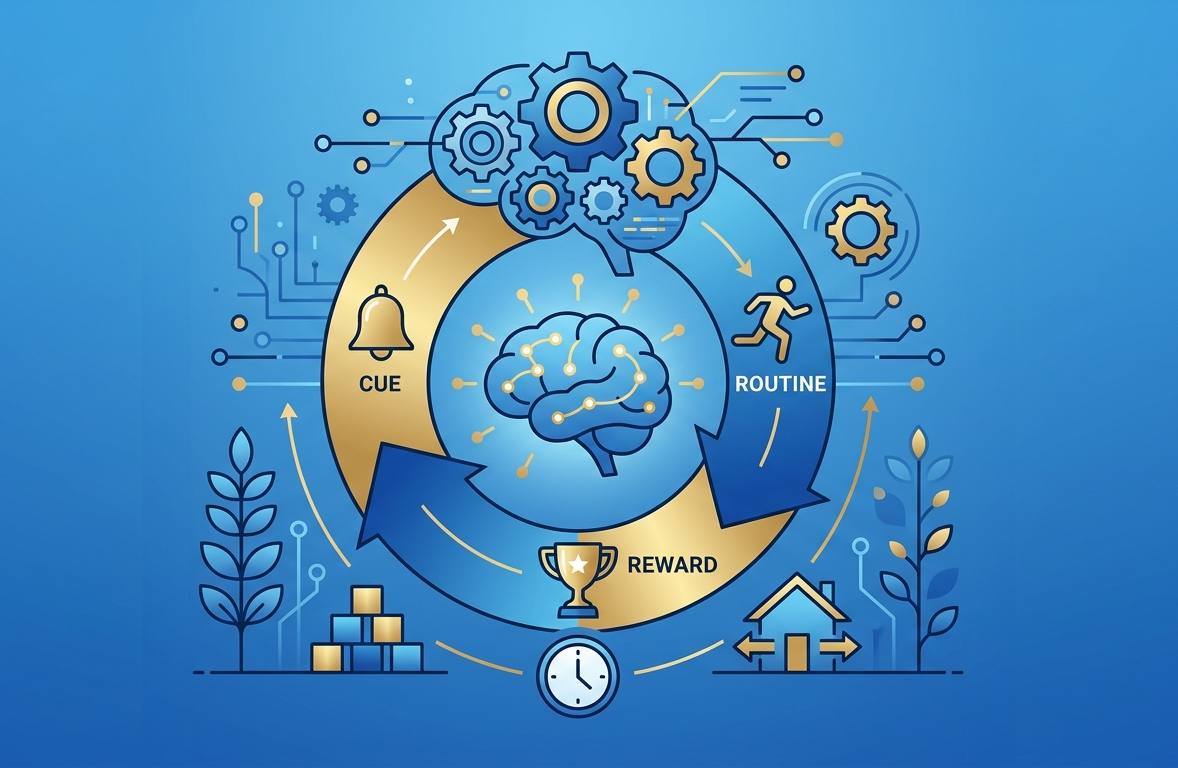
To change a habit, you first have to understand what it looks like under a microscope. In the 1990s, researchers at the Massachusetts Institute of Technology (MIT) discovered a simple, three-part neurological loop at the core of every single habit.
This concept, popularized by Charles Duhigg in The Power of Habit, breaks down into a continuous cycle:
- The Cue: A trigger that tells your brain to go into automatic mode and which habit to use.
- The Routine: The physical, mental, or emotional behavior that follows the cue.
- The Reward: A positive stimulus that tells your brain, “Hey, this felt great. Remember this for next time.”
The Basal Ganglia vs. The Prefrontal Cortex
When you learn a new behavior, your prefrontal cortex—the conscious, decision-making part of your brain—is working overtime. Think about the first time you tried to drive a car. You had to actively think about the mirrors, the pedals, the blind spots, and the steering wheel all at once. It was exhausting.
However, once you’ve driven for a few years, you can drive all the way to work while listening to a podcast, completely on autopilot.
What happened? The brain storage shifted. As a behavior becomes automatic, the mental activity shifts from the energy-hungry prefrontal cortex to the basal ganglia, an ancient, golf-ball-sized structure deep in the brain responsible for pattern recognition and automatic behaviors.
The brain does this for a beautiful reason: efficiency. Your brain makes up about 2% of your body weight but consumes roughly 20% of its energy. By turning recurring behaviors into automatic habits, the brain conserves precious mental energy for unexpected crises or complex problem-solving.
The Myth of the “21-Day” Rule
You’ve probably heard that it takes exactly 21 days to form a habit. This is a massive myth born from a misunderstanding of a 1960 book called Psycho-Cybernetics by Dr. Maxwell Maltz, a plastic surgeon who noticed it took his patients about 21 days to get used to their new faces.
If you’ve tried and failed to build a habit in three weeks, don’t beat yourself up. A landmark study published in The European Journal of Social Psychology by Dr. Phillippa Lally examined how long it actually takes to form a habit.
The researchers found that on average, it takes 66 days for a new behavior to become automatic.
Depending on the complexity of the habit and your personality, the timeline actually ranged anywhere from 18 to 254 days.
The takeaway? Habit formation is a marathon, not a sprint. Missing a single day won’t ruin your progress, but consistency over the long haul is what rewires the neural pathways.
Neuroplasticity: Rewiring Your Brain
For decades, scientists believed that the adult brain was fixed and unchangeable. We now know this is false thanks to a concept called neuroplasticity—the brain’s ability to reorganize itself by forming new neural connections throughout life.
Think of your brain like a dense forest. The first time you try a new habit (like journaling at night), you have to hack through thick brush and weeds. It’s difficult and takes effort. But the more you walk that path, the clearer it becomes. Eventually, it becomes a paved highway.
Conversely, when you stop practicing a bad habit, that old highway slowly gets overgrown with weeds from disuse. Neurons that fire together, wire together. Your job is simply to help the right neurons meet.
4 Practical Strategies to Build Good Habits
Knowing the science is great, but how do we apply it to tomorrow morning? Borrowing principles from behavioral science and James Clear’s Atomic Habits, here are four highly actionable, science-backed strategies to build habits that stick.
1. Habit Stacking (Anchor to the Familiar)
Don’t try to build a habit out of thin air. Instead, hitch a ride on an established highway in your brain. Habit stacking is a method where you identify a current habit you already do every single day (your anchor) and stack your new behavior right on top of it.
The formula is simple:
After [Current Habit], I will [New Habit]
- Instead of: “I am going to meditate more.”
- Try: “After I pour my morning cup of coffee, I will sit on the couch and meditate for two minutes.”
- Instead of: “I need to floss.”
- Try: “After I put my toothbrush back in the holder, I will immediately floss one tooth.”
By anchoring the new behavior to an unshakeable cue, you eliminate the friction of needing to remember to do it.
2. Optimize for the First 2 Minutes
When we start a new routine, we tend to overcomplicate it. We try to go from sedentary to running five miles a day. This causes mental friction, and your prefrontal cortex will quickly vote to cancel the subscription.
Instead, use the Two-Minute Rule. Scale down your new habit until it takes two minutes or less to do.
- “Read one book a week” becomes “Read one page.”
- “Do 30 minutes of yoga” becomes “Take out my yoga mat.”
- “Study for my exams” becomes “Open my notes.”
The goal here isn’t the outcome; it’s mastering the art of showing up. A habit must be established before it can be improved. Once you’re on the yoga mat, you’ll usually find the momentum to keep going.
3. Redesign Your Environment
We like to think we have high superpower levels of self-control, but behavioral science shows that our environment shapes our behavior far more than our willpower. If you want to drink more water, but your desk is empty and there’s a soda in the fridge, you’re going to drink the soda.
Make the cues for your good habits incredibly obvious, and hide the cues for your bad habits.
| Desired Goal | How to Change Your Environment |
| Read more books | Place a book on your pillow every morning when you make your bed. |
| Eat healthier | Wash fresh fruit and place it in a glass bowl right in the center of the kitchen counter. |
| Reduce screen time | Put your phone in a drawer in another room at 8:00 PM. |
Make it easy to do right, and hard to do wrong.
4. Create an Immediate Reward (The Dopamine Hook)
Our brains evolved in what scientists call an immediate-return environment. In the wild, actions had immediate consequences (hunt food $\rightarrow$ eat food). Today, we live in a delayed-return environment (work hard today $\rightarrow$ get a paycheck in three weeks).
Because your brain loves instant gratification, it craves dopamine—the neurotransmitter associated with pleasure and anticipation.
To make a good habit stick, you need to find a way to give yourself an immediate, satisfying reward. This can be as simple as checking a box on a physical habit tracker. The visual satisfaction of crossing off a day triggers a small hit of dopamine, reinforcing the habit loop.
My Personal Philosophy: Focus on Identity, Not Goals
If there is one thing I’ve learned on my own journey of trading bad habits for better ones, it’s this: True behavior change is actually identity change.
When you focus only on goals (e.g., “I want to lose 20 pounds”), you are focusing on an outcome. Once you hit the outcome—or if progress is too slow—you lose the motivation to keep going.
Instead, focus on who you want to become.
- Don’t focus on running a marathon; focus on becoming a runner.
- Don’t focus on writing a book; focus on becoming a writer.
Every time you choose a healthy snack, do a two-minute stretch, or read a single page, you are casting a vote for the type of person you want to be. You don’t need a perfect ballot to win an election; you just need a majority of the votes.
Be patient with your biology, design your environment for success, and remember that small, incremental 1% improvements everyday yield massive transformations over time.
Sources & Further Reading
Yin, H. H., & Knowlton, B. J. (2006). The role of the basal ganglia in habit formation. Nature Reviews Neuroscience, 7(6), 464–476.
Duhigg, C. (2012). The Power of Habit: Why We Do What We Do in Life and Business. Random House.
Clear, J. (2018). Atomic Habits: An Easy & Proven Way to Build Good Habits & Break Bad Ones. Penguin Random House.
Lally, P., van Jaarsveld, C. H. M., Potts, H. W. W., & Wardle, J. (2010). How are habits formed: Modelling habit formation in the real world. European Journal of Social Psychology, 40(6), 998–1009.

Leave a Reply