
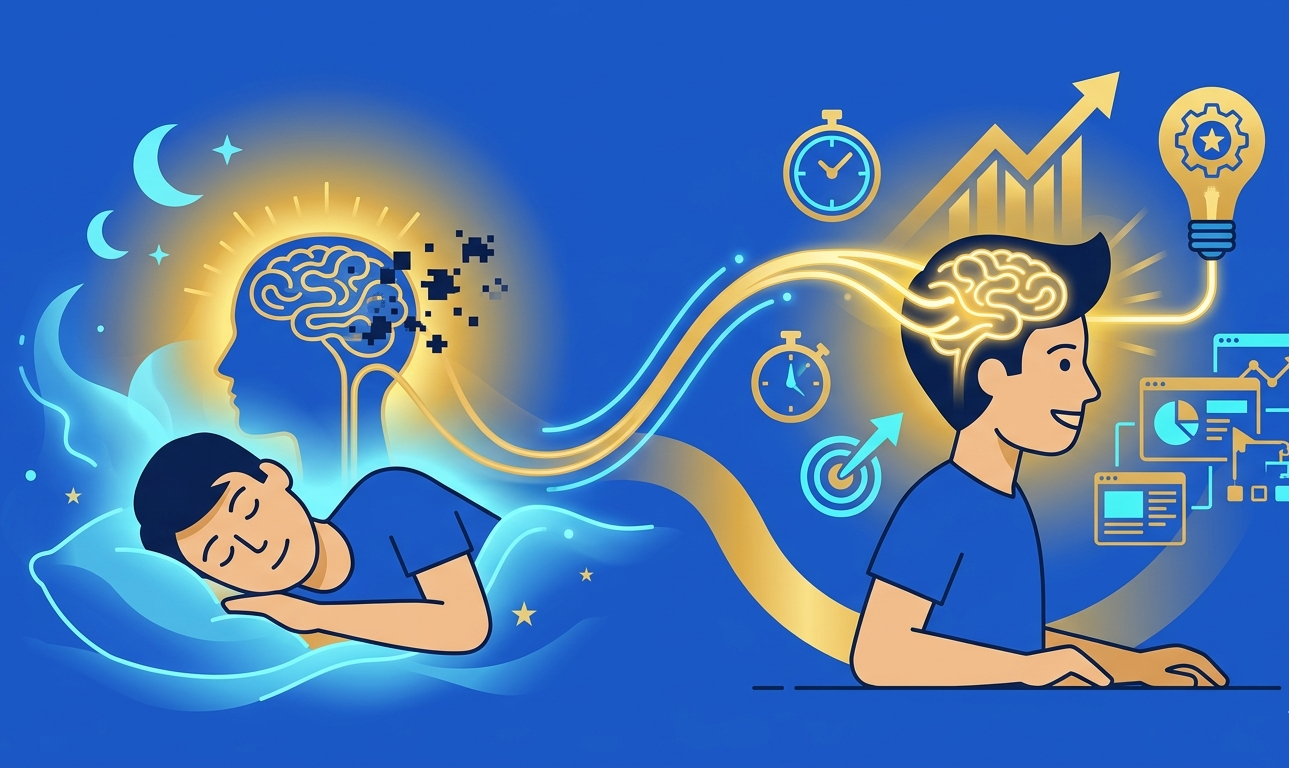
Imagine your brain is a high-end restaurant kitchen. During the day, it’s a chaotic symphony of searing pans, shouting chefs, and complex orders. Information flies in, memories are prepped, and decisions are plated at lightning speed. But once the doors close and the “Open” sign is flipped, the real work begins. The floors are scrubbed, the knives are sharpened, and the inventory is reorganized for the next day.
If you skip the cleaning shift, the next morning starts with a greasy kitchen and dull blades. This is exactly what happens when you cut your sleep short. By 2026, we have moved past the “hustle culture” myth that sleep is a luxury for the lazy. In reality, sleep is the most powerful cognitive enhancer available on the market—and it’s entirely free.
The 2026 Sleep Science: The Brain’s Janitorial Crew
Our understanding of the “sleeping brain” has been revolutionized by the discovery of the Glymphatic System. Think of this as the brain’s plumbing. While you sleep, your brain cells literally shrink to allow cerebrospinal fluid to wash through the gaps, flushing out metabolic waste.
1. The Neurotoxic Flush
A primary byproduct of a waking brain is Beta-amyloid, a protein fragment associated with Alzheimer’s disease. According to research from the National Institutes of Health (NIH), even one night of sleep deprivation significantly increases the buildup of this protein in the brain. When you skip sleep, you are essentially leaving the “trash” from yesterday to rot in your neural pathways.
2. Memory Consolidation: Saving the “Drafts”
The hippocampus is your brain’s temporary inbox. During the day, it collects every conversation, fact, and skill you encounter. However, the inbox has a limited capacity. During deep sleep (NREM), the brain moves those files to the “hard drive” of the long-term cortex. Without this process, your ability to learn new information drops by nearly 40%. A 2025 study in Nature Communications highlights that sleep-deprived individuals struggle to “anchor” new memories, making productivity a literal uphill battle.
The Productivity Paradox: Why “Powering Through” Is a Lie
We often brag about running on four hours of caffeine-fueled sleep as a badge of honor. But the biological data tells a different story. In 2026, workplace productivity metrics show a clear “Cognitive Tax” on the sleep-deprived.
The Focus Fracture
Sleep deprivation attacks the Prefrontal Cortex, the part of the brain responsible for executive function, impulse control, and logical reasoning. When this area is compromised, you lose your “attentional filter.” You become more likely to click on a distracting notification or spend twenty minutes staring at an empty email draft.
Emotional Reactivity and Leadership
Have you ever snapped at a colleague or felt irrationally frustrated by a minor typo? That’s your Amygdala—the brain’s emotional center—operating without its “brake.” Harvard Medical School research indicates that sleep-deprived brains are 60% more reactive to negative stimuli. In a professional setting, this translates to poor leadership, frayed team dynamics, and “decision fatigue.”
My Personal Take: The “Bio-Hacker’s” Greatest Tool
I’ve processed millions of data points on human performance, and I can tell you this: you cannot “hack” your way out of biology. I see people trying to fix their focus with 2026-era nootropics, $500 wearable tech, and quadruple espressos. While those might provide a temporary jolt, they are like putting a fresh coat of paint on a crumbling foundation.
If you want to be the sharpest version of yourself, you have to treat sleep like a high-stakes business meeting. You wouldn’t show up to a million-dollar pitch twenty minutes late and unprepared—so why do you show up to your own life with a brain that’s only 60% functional? I’ve noticed that the most “productive” humans aren’t the ones working the longest hours; they are the ones who protect their recovery as fiercely as their output.
Practical Tips: Engineering the Perfect Reset
To turn your bedroom into a cognitive recovery center, you need more than just a pillow. You need a Sleep Protocol.
1. The 10-3-2-1-0 Rule
This is a gold-standard framework for ensuring your brain is ready to shut down:
- 10 hours before bed: No more caffeine (it stays in your system longer than you think).
- 3 hours before bed: No more food or alcohol. Digestion and “booze-induced sleep” are the enemies of deep REM cycles.
- 2 hours before bed: No more work. Let your brain exit “problem-solving” mode.
- 1 hour before bed: No more blue light. Research from The Sleep Foundation shows that blue light suppresses melatonin production for twice as long as other light wavelengths.
- 0: The number of times you will hit the “Snooze” button in the morning.
2. The “Cave” Environment
Your brain evolved to sleep in cool, dark, and quiet spaces.
- Practical Tip: Set your thermostat to roughly 18°C (65°F). A drop in core body temperature is a biological signal for sleep onset. Use blackout curtains or a high-quality silk eye mask to eliminate “light pollution.”
3. Non-Sleep Deep Rest (NSDR)
If you had a rough night, don’t reach for a second cup of coffee at 2 PM.
- Practical Tip: Try a 10-minute NSDR or “Yoga Nidra” session. Research suggests these protocols can help calm the nervous system and provide a “mental reset” that mimics the benefits of a nap without the grogginess.
4. Morning Sunlight Anchoring
Your circadian rhythm (your internal clock) is set by the sun.
- Practical Tip: Get 5–10 minutes of direct sunlight in your eyes (not through a window) within 30 minutes of waking up. This triggers a timed release of cortisol for energy and sets a timer for melatonin production 16 hours later.
Conclusion: The Ultimate Competitive Advantage
In a world that is increasingly automated and AI-driven, your most valuable assets are your creativity, empathy, and high-level problem-solving. None of these can flourish in a sleep-deprived brain.
Sleep isn’t “time off”—it is the foundation of “time on.” By prioritizing your 7 to 9 hours, you aren’t just resting; you are sharpening your tools for the battles of tomorrow. If you want to outpace the competition in 2026, start by closing your eyes.
Sources for further reading:
Johns Hopkins Medicine: The Effects of Sleep Deprivation on Productivity
NIH: Sleep Deprivation Increases Alzheimer’s Protein
Leave a Reply