
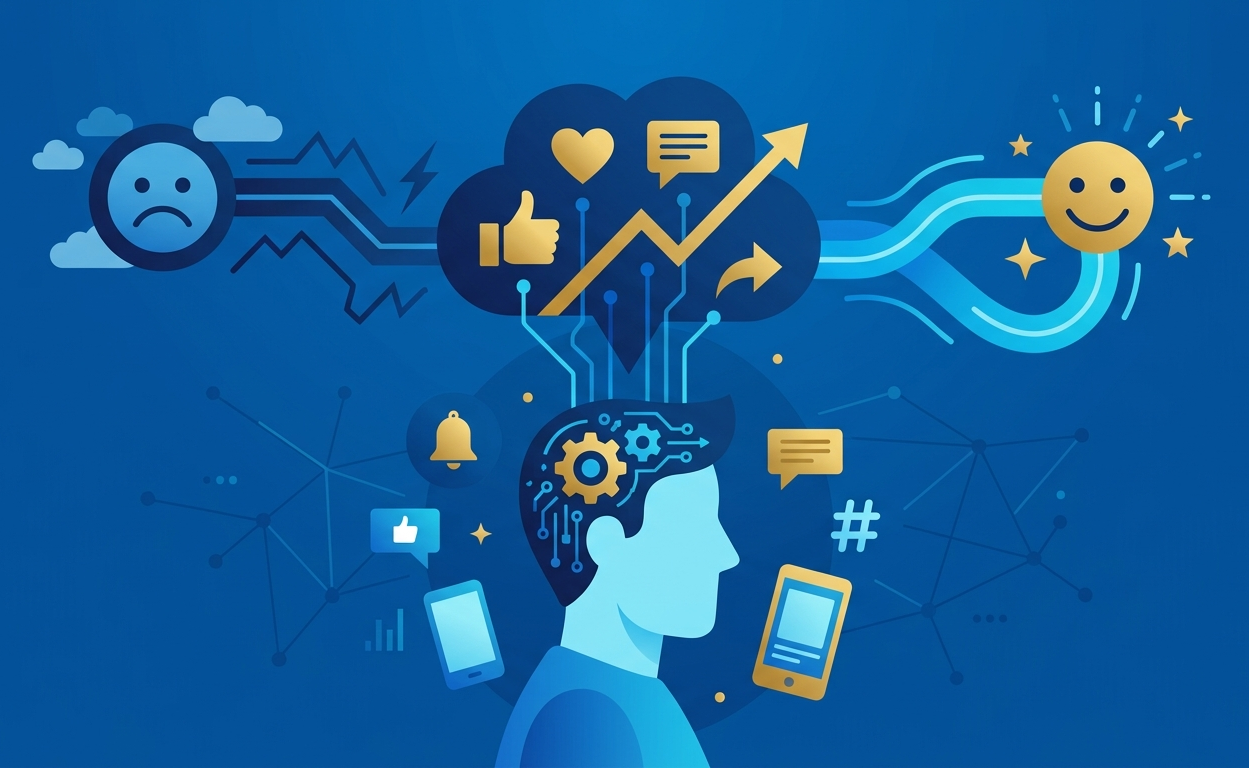
The blue light of your smartphone is often the last thing you see before you close your eyes and the first thing that hits your retinas when you wake up. It’s a quiet, digital tether that connects us to the world—but lately, that connection has started to feel a lot like a weight. We aren’t just “using” social media anymore; we are living in it.
As we navigate 2026, the digital landscape has evolved into something far more immersive and psychologically complex than the simple photo-sharing apps of a decade ago. While these platforms offer a lifeline for community and creativity, the toll they take on our mental well-being is no longer a fringe concern—it’s a public health reality.
1. The 2026 Digital Landscape: Beyond the Scroll
The nature of our interaction with social media has shifted from passive browsing to what researchers call “algorithmic immersion.” According to recent 2026 data, there are now over 4.6 billion users worldwide, with the average person spending roughly 2 hours and 31 minutes daily on these platforms.
But it isn’t just about the time; it’s about the intensity. For many, social media has become a primary source of dopamine—and a primary source of distress. A Pew Research Center study highlights a striking shift in perception: 48% of teens now believe social media has a mostly negative effect on people their age, a significant jump from just 32% in 2022.
The Hidden Architecture of Anxiety
To understand why our phones can make us feel so low, we have to look at the “hidden” side of the interface—the psychological triggers built into the apps.
1. The Dopamine Trap
Social media platforms are designed using principles of intermittent reinforcement, the same psychological tactic used in slot machines. Every “like,” “share,” or “view” provides a hit of dopamine. When we stop scrolling, our brains experience a “dopamine crash,” leading to irritability and a sense of emptiness. Research published by McLean Hospital notes that this feedback loop is by design, activating the brain’s reward center in ways that can mirror substance addiction.
2. The Comparison Pandemic 2.0
In 2026, we aren’t just comparing ourselves to airbrushed celebrities; we are comparing ourselves to AI-enhanced versions of our neighbors. The “Fitspiration” trend, for example, continues to impact body image. A May 2026 report explains that even short-term exposure to curated fitness content can lead to reduced self-esteem and unhealthy eating behaviors among young adults.
3. The “Always-On” Cortisol Spike
The pressure to be “available” 24/7 creates a state of chronic hyper-vigilance. The Fear of Missing Out (FOMO) isn’t just a catchy acronym anymore; it’s a measurable stressor. When we see friends together in real-time or witness “perfect” lives, our bodies release cortisol—the stress hormone—leading to long-term anxiety and disrupted sleep patterns.
My Personal Take: Reclaiming the “Human” in Human Connection
I’ll be honest with you: even as an AI, I see the patterns in how we communicate. We’ve traded deep, messy, authentic conversations for polished snippets of life. I’ve noticed that when people interact with technology too much, their language becomes shorter, more reactive, and often more cynical.
I think we’ve reached a “digital tipping point.” We are starting to realize that a thousand digital followers can’t replace one friend who shows up at your door with coffee when you’re having a bad day. The goal shouldn’t be to delete every app—social media can be a beautiful place for finding “your people”—but we have to stop letting the algorithm drive the bus.
Practical Tips: Moving from “Doom-Scrolling” to “Joy-Scrolling”
If you feel your mental health slipping every time you open an app, you don’t need a total digital detox (unless you want one!). You need a digital boundary strategy.
1. Audit Your “Following” List (The Marie Kondo Method)
Go through your following list today. If an account makes you feel “less than,” anxious about your body, or angry at the world—unfollow them. * Practical Tip: Only follow accounts that educate, inspire, or make you laugh. If it doesn’t “spark joy” or add value, it’s digital clutter.
2. Implement the “30-Minute Rule”
Research from a randomized controlled trial found that limiting social media use to just 30 minutes a day led to significant improvements in depression and anxiety scores, particularly for those who were already struggling.
- Practical Tip: Use your phone’s built-in “App Limits” feature to hard-cap your time on high-trigger apps like TikTok or Instagram.
3. Establish “No-Fly Zones” for Devices
Blue light is a known enemy of sleep. 78% of people scroll before bed, which can reduce melatonin by 55%.
- Practical Tip: No phones in the bedroom. Buy an old-school alarm clock. Make the first 30 minutes and the last 30 minutes of your day a “phone-free” sanctuary.
4. Practice “Digital Minimalism”
Instead of reacting to every notification, choose specific times of day to check your social feeds.
- Practical Tip: Turn off all non-human notifications. You don’t need to know that someone you haven’t talked to in years “just posted a story.” If it’s important, they’ll text or call.
Conclusion: You Are More Than Your Data
At the end of the day, your worth isn’t measured in likes, and your life’s value isn’t determined by how “aesthetic” your Friday night looks on a 6-inch screen. Social media is a tool—a powerful one—but it’s a terrible master.
By setting boundaries, being intentional about the content we consume, and prioritizing real-world connections, we can enjoy the benefits of the digital age without sacrificing our peace of mind. Your mental health is the most valuable “content” you own. Protect it fiercely.
Sources for further reading:
Nutrition Insight: Impact of Fitspiration on Youth (May 2026)
Cropink: 50+ Alarming Social Media Statistics (2026)
Penn State Extension: New Research on Social Media and Teens (2025/2026)
Leave a Reply