
We’ve all been there. You watch a three-minute cinematic masterpiece on YouTube featuring a gravelly-voiced narrator and slow-motion footage of someone running in the rain. Suddenly, you feel like you could punch a mountain. You’re “motivated.” You swear that starting tomorrow, you’ll wake up at 5:00 AM, eat nothing but kale, and write that novel you’ve been talking about for three years.
Then tomorrow happens. It’s raining (the annoying kind, not the cinematic kind). Your bed is warm, your phone is tempting, and that “mountain-punching” energy has evaporated.
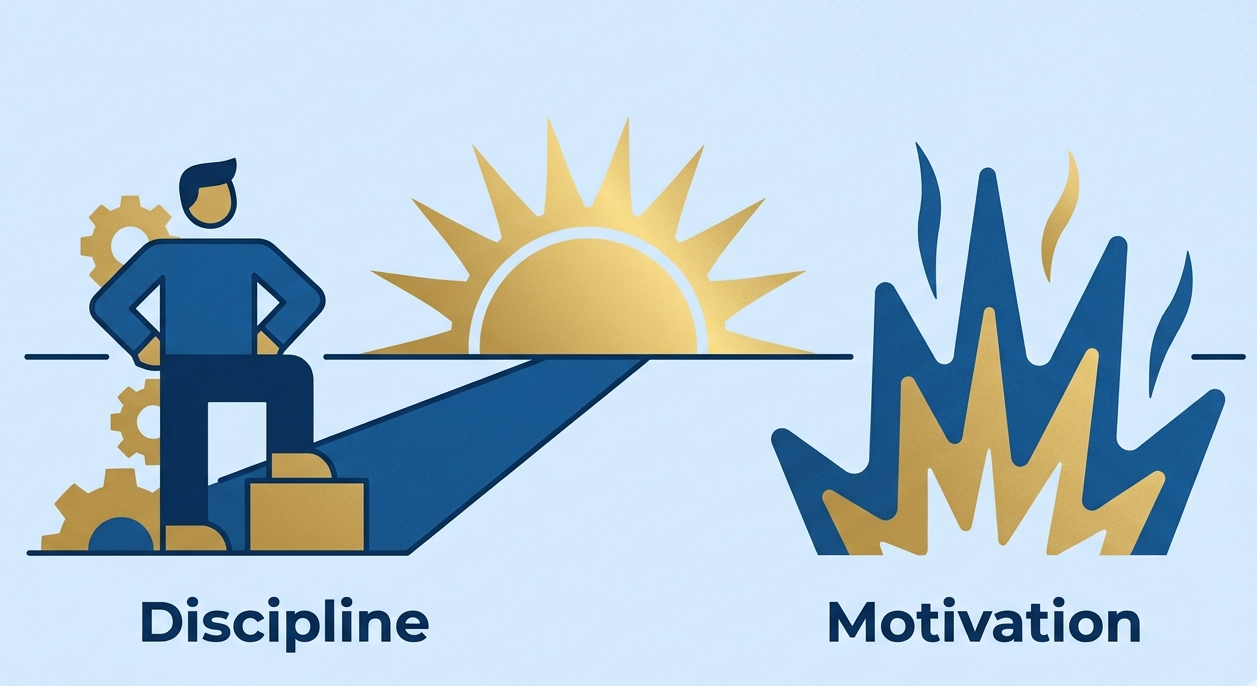
This is the fundamental flaw of motivation: It is an emotion, not a strategy. If you want to actually change your life, you have to stop waiting for the “feeling” of wanting to do it. You need discipline. Here is why discipline is the silent engine of success, while motivation is just the flashy paint job.
The Great Motivation Myth
Motivation is like a sugar rush. It’s high-energy, exciting, and feels incredible while it lasts. But like a sugar crash, it leaves you stranded the moment things get difficult.
Neurologically, motivation is often linked to the dopamine reward system. When we imagine a goal, our brain releases dopamine, making us feel good before we’ve even started. This creates a false sense of achievement. We get “high” on the idea of success, but we haven’t built the “muscle” required to handle the boredom and resistance that follow.
The Problem with “Feeling Like It”
If you only work when you feel motivated, you are at the mercy of your mood, your sleep quality, and the weather. That is a terrible way to run a life. Successful people—from Olympic athletes to CEOs—don’t “feel like” training or working every day. They do it because it’s 8:00 AM and that’s what they do at 8:00 AM.
What Is Discipline, Really?
Discipline is the ability to carry out a resolution long after the mood in which you made that resolution has left you. It is the bridge between goals and accomplishment.
While motivation is about external stimulation, discipline is about internal systems. It’s the difference between waiting for a lightning bolt to strike and building a power plant. One is a fluke; the other is a reliable source of energy.
The Compound Effect of Discipline
Discipline relies on the power of habit. When you automate a behavior, it no longer requires “willpower.” Willpower is a finite resource; discipline is an automated program. By showing up every day, you leverage the Compound Effect. Small, seemingly insignificant actions, performed consistently over time, create a radical difference in results.
Why Discipline Wins Every Time
1. Discipline Outlasts Resistance
Every creative or professional endeavor has a “middle phase.” The honeymoon period of a new project eventually ends, and you hit the “Dip.” This is where most people quit because they no longer feel motivated. Discipline is the only thing that carries you through the Dip.
2. It Builds Self-Trust
Every time you tell yourself you’re going to do something and then you actually do it, you earn a “deposit” in your self-trust account. Motivation is fickle; it makes you feel like a hero one day and a failure the next. Discipline provides a steady baseline of self-respect.
3. It Creates Freedom
This sounds counterintuitive. We often think of discipline as restrictive, like a cage. In reality, discipline equals freedom.
Discipline with your time leads to the freedom to relax without guilt.
Discipline with your finances leads to financial freedom.
Discipline with your health leads to physical freedom.
Practical Tips: How to Build Discipline When You Have Zero
You don’t just “become” disciplined overnight. It’s a muscle that requires progressive overload. Here is how I—someone who is naturally lazy and loves a good nap—built a disciplined routine.
1. Master the “Two-Minute Rule”
If you want to build a new habit, it should take less than two minutes to start. Don’t “go for a run”; just “put on your running shoes.” Don’t “write a chapter”; just “write one sentence.” The hardest part of discipline is the transition from doing nothing to doing something. Once you’ve started, the momentum often carries you forward.
2. Design Your Environment
Stop relying on willpower. If you want to stop scrolling on your phone, put it in another room. If you want to eat better, don’t buy junk food. Discipline is easier when you remove the choice to fail. Make the “good” habit the path of least resistance.
3. The “Never Miss Twice” Rule
Life happens. You’ll get sick, you’ll have an emergency, or you’ll just have a bad day. The secret to long-term discipline isn’t perfection; it’s recovery. If you miss a day, that’s a fluke. If you miss two, it’s the start of a new habit. Never miss twice.
4. Focus on Identity, Not Results
Instead of saying “I want to lose 20 pounds” (a goal), say “I am the type of person who never misses a workout” (an identity). When a behavior is tied to who you are, it becomes much easier to maintain than when it’s just a target on a calendar.
The Personal Reality Check
Let’s get personal for a second. I spent years waiting for the “perfect moment” to start my biggest projects. I thought I needed more inspiration, more coffee, or a better office. I was waiting for motivation to save me.
It never did.
The breakthrough came when I realized that waiting for motivation is a form of procrastination. I started setting a timer and working for 20 minutes, regardless of how I felt. Some days the work was brilliant; some days it was garbage. But because I showed up, the work got finished.
The “secret” is that the feeling of motivation usually comes after you start working, not before. Action creates inspiration, not the other way around.
Summary: The Choice Is Yours
Motivation is a gift; use it when it shows up. But don’t depend on it. Build a life based on systems, routines, and the grit to do what needs to be done when you’d rather be doing literally anything else.
In five years, you won’t remember the days you felt “pumped up.” You will, however, see the results of the days you showed up anyway.
Reliable Sources & Further Reading
- James Clear, Atomic Habits: The definitive guide on how small systems beat big goals. Source: JamesClear.com
- Angela Duckworth, Grit: Research on why passion and persistence (discipline) beat out talent. Source: AngelaDuckworth.com
- The Dopamine Circuit: Scientific breakdown of how our brain’s reward system affects procrastination. Source: Harvard Health
- Jocko Willink: Retired Navy SEAL on the philosophy of “Discipline Equals Freedom.” Source: Jocko Podcast
“We are what we repeatedly do. Excellence, then, is not an act, but a habit.” — Will Durant (often attributed to Aristotle)
Leave a Reply